
Beyond the Peptide Label: What 5-Amino-1MQ Really Is and Why Product Classification Alters How You Compare Vials, Capsules, and Bulk Raw Material
In this article
In online biohacking circles and research forums, few compounds generate as much lively debate as 5-Amino-1MQ. A quick glance at communities like Reddit’s r/Biohacking reveals a recurring point of confusion among buyers awaiting their shipments—frequently referring to incoming packages in terms like "I have a 50mg bottle coming". Yet, seasoned compound enthusiasts and analytical researchers are quick to correct a fundamental misconception: despite often being grouped alongside traditional peptide catalogs, 5-Amino-1MQ is not actually a peptide at all.
For clinics, aesthetic facilities, independent researchers, and commercial resellers navigating the supply chain, understanding this distinction is more than an exercise in semantics. It directly dictates how you interpret analytical reports, evaluate pricing structures, and compare liquid solutions, oral capsules, and bulk crystalline powder.
The Molecular Reality: Why 5-Amino-1MQ Is Not a Peptide
To understand why classification matters, we must first look at chemical structure. Traditional peptides—such as BPC-157 or GHK-Cu—are short chains of amino acids linked by peptide bonds. They are typically synthesized via solid-phase peptide synthesis and are structurally sensitive to enzymatic degradation, which is why many require reconstitution and cold-chain storage.
5-Amino-1MQ operates entirely differently. Mechanistically evaluated as a small molecule inhibitor of nicotinamide N-methyltransferase (NNMT)—an enzyme heavily implicated in cellular energy homeostasis and adipogenesis—5-Amino-1MQ is formally classified as a quinolinium derivative (a small organic molecule) rather than an amino acid chain. Landmark preclinical literature, such as research published via PubMed Central (PMC5826726), highlights its role in reducing white adipose tissue accumulation and altering cellular metabolism through targeted enzymatic inhibition.
Because it is a stable small molecule rather than a fragile peptide sequence, its physical and chemical properties diverge sharply from standard peptide compounds. This structural reality shapes how laboratories handle it, how manufacturers process it, and why procurement managers often find themselves confused when comparing market quotes.
The Sourcing Maze: Vials vs. Capsules vs. Raw Powder
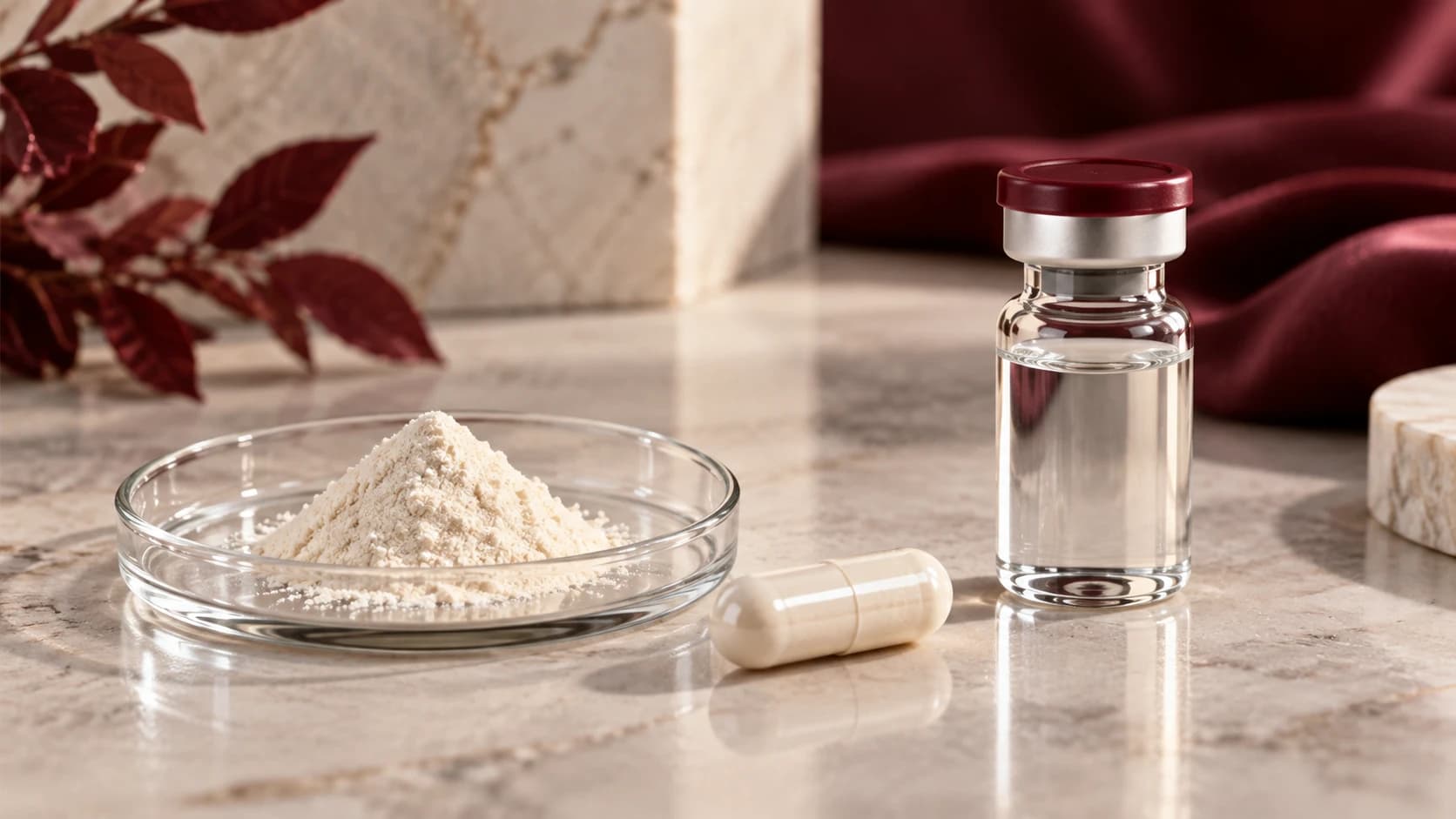
When procurement officers or independent investigators set out to source 5-Amino-1MQ, they encounter three distinct product formats: lyophilized vials, oral capsules, and raw crystalline powder. Because buyers frequently cross-shop these categories as if they were interchangeable, they often run into mismatched pricing, confusing concentration metrics, and contradictory usage guidelines.
1. Lyophilized Vials (Reconstitution Formats)
- The Context: Vials are historically associated with peptide research, leading some suppliers to package small-molecule inhibitors into vacuum-sealed cake formats intended for reconstitution with bacteriostatic water.
- The Pricing Pitfall: Vials are typically priced per milligram of active content per unit, factoring in the cost of glass, stoppers, and freeze-drying cycles. Comparing a lyophilized vial directly to bulk powder often makes vials appear exponentially more expensive, skewing budget calculations for laboratories that have the infrastructure to compound their own solutions.
2. Oral Capsules and Finished Dose Blends
- The Context: Given its oral bioavailability profile, 5-Amino-1MQ is frequently formulated into capsules, sometimes paired with complementary metabolic compounds or co-factors.
- The Pricing Pitfall: Finished consumer or clinical-grade capsules include manufacturing overhead, excipients, encapsulation labor, and brand packaging. Evaluating a capsule's price per bottle against a raw material wholesale quote is an apples-to-oranges comparison. Furthermore, finished blends can obscure the exact mass percentage of the active quinolinium compound unless verified by robust analytical documentation.
3. Bulk Raw Crystalline Powder
- The Context: Sourced primarily by compounding pharmacies, research institutions, and large-scale resellers, bulk powder is traded by the gram or kilogram.
- The Pricing Pitfall: Raw material quotes appear dramatically lower on a per-milligram basis, but buying raw powder shifts the burden of purity verification, precise analytical testing, and safe handling entirely onto the buyer. Without proper laboratory equipment, verifying salt forms (such as iodide vs. chloride variants) and achieving homogeneous dilution becomes a significant operational hurdle.
Navigating Specifications and Protecting Your Supply Chain
Whether you operate a specialized wellness clinic, manage a retail resale catalog, or direct an independent testing laboratory, supply chain integrity relies on looking past marketing terminology. When evaluating suppliers, procurement professionals should demand rigorous transparency:
- Verify Analytical Documentation: Never rely solely on product descriptions. Cross-reference batch numbers using dedicated verification portals, such as the Corapep COA Verification Portal, to review independent high-performance liquid chromatography (HPLC) and mass spectrometry data.
- Examine the Complete Catalog: To explore technical specifications, molecular weights, and handling parameters designed specifically for investigative applications, review the dedicated Corapep 5-Amino-1MQ Research Hub.
- Assess Direct Product Availability: For researchers and institutions ready to evaluate standard catalog options, the Corapep 5-Amino-1MQ Product Page outlines current material specifications.
For high-volume purchasers, commercial distributors, or institutional buyers requiring customized fulfillment terms, bypassing retail channels in favor of direct dialogue is often the most efficient path forward. You can initiate a direct inquiry through the Corapep Request Quote Portal to discuss precise volume tiers and documentation requirements.
Conclusion
The ongoing discussions across platforms like Reddit underscore a broader truth about modern chemical and biochemical sourcing: nomenclature matters. By recognizing that 5-Amino-1MQ is a quinolinium small molecule rather than a peptide, buyers can sidestep the trap of incompatible pricing comparisons. Whether your facility requires precise analytical quantities in specialized formats or bulk raw materials for downstream compounding, anchoring your purchasing decisions in verifiable analytical data ensures clarity, safety, and scientific rigor.